Pro Moves Hockey Camp Toronto 2026
The Power Skating
Behind Elite Hockey Moves
Pro Moves Hockey Camp Toronto 2026
Learn the movement patterns elite players use to deceive defenders, protect the puck, escape pressure, create separation, and control the game.
Players first build the skating mechanics behind each move. They then apply those movements with the puck, against pressure, and in realistic game situations.
August 3–7, 2026 | Canlan York
Arena: Canlan York
FIVE PRO MOVES THEMES
Five Game Situations.
One Complete Skating Skillset.
Players will work on edge control, balance, transitions, direction changes, acceleration, lateral movement, and puck control throughout the entire week.
What changes each day is the way those movements are applied.
Every theme is built around a recognizable game situation and inspired by the movement patterns elite players use to create an advantage.
McDavid-Inspired Attack Deception
Make the Defender Commit
Connor McDavid does not rely only on straight-line speed. He changes his angle, direction, rhythm, and body position to force defenders to move before he attacks the open space.
Players will learn how to combine lateral movement, weight shifts, crossovers, edge changes, and acceleration to become less predictable when attacking one-on-one.
During the application phase, players will use these movements to challenge defenders, create an opening, and attack through or around pressure.
Game outcome: Move the defender first, then attack the space they give up.
Deceptive Zone Entries
Enter the Offensive Zone With More Than One Option
Successful zone entries require more than carrying the puck forward at speed.
Players need to control their approach, read the defender’s gap, change their attack angle, and present multiple options before crossing the blue line.
Players will work on changes of speed, lateral cuts, delays, direction changes, puck positioning, and deceptive body movement.
During the application phase, players will use these tools to attack the middle, drive wide, delay, cut across the defender, or create space for the next play.
Game outcome: Enter the zone under control without becoming predictable.
Hughes-Inspired Blue-Line Mobility
Change the Angle Without Losing the Play
Quinn Hughes uses fluid lateral movement, transitions, open hips, and changes of direction to stay mobile across the offensive blue line.
Instead of remaining in one lane, he continually changes his position to create a better passing lane, shooting angle, or route around pressure.
Players will work on lateral acceleration, crossovers, pivots, transitions, and puck control while moving across the blue line.
During the application phase, players will learn how to walk the line, move around pressure, maintain possession, and create a better offensive option.
Game outcome: Stay mobile and change the point of attack.
Puck Protection and Pressure Escapes
Use Your Skating to Keep Possession
Puck protection is not only about strength. It begins with skating position, edge control, puck placement, and the ability to change direction when pressure arrives.
Players will work on open-hip movement, mohawks, reverse mohawks, cutbacks, tight turns, body positioning, and acceleration away from contact.
During the application phase, players will use these movements along the boards, in the corner, and during puck retrievals to protect possession and escape with control.
Game outcome: Keep the puck, create separation, and find the next option.
Corner and Behind-the-Net Escapes
Create Space in Tight Areas
Behind the net and in the corners, players have less time, less space, and pressure coming from multiple directions.
The goal is not simply to protect the puck. It is to use skating, deception, and body positioning to escape pressure and create the next play.
Players will work on tight turns, cutbacks, reverse escapes, open-hip movement, changes of direction, puck placement, and acceleration out of confined areas.
Game outcome: Escape pressure, create separation, and turn a tight-area situation into an offensive opportunity.
Camp Structure
Learn the Move. Use the Move.
First Hour
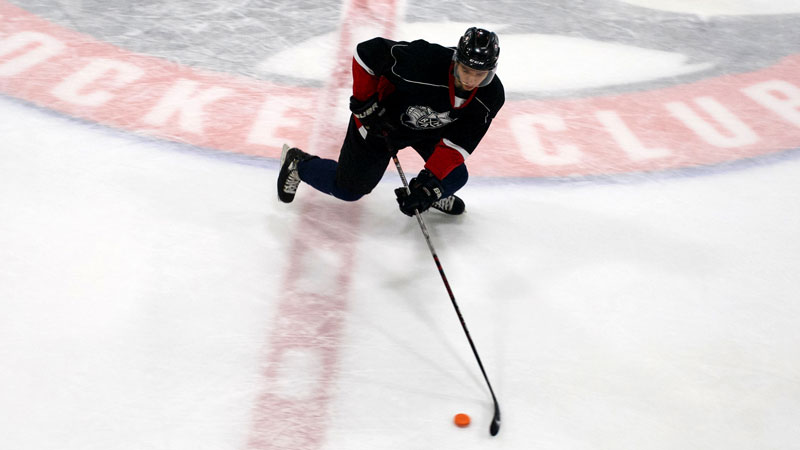
Build the Move
Players learn the technical foundation required to perform each movement efficiently, confidently, and under control. The goal is to help players understand how the movement works and develop the control needed to execute it consistently.
Second Hour

Apply the Move
Players take the same movement and use it in specific hockey situations.
They learn how the movement can help them create an advantage, respond to pressure, and choose between multiple options based on how the play develops.
The focus shifts from simply performing the move to recognizing when, where, and why to use it in the game.
Power skating Camp Info
Details
- July 13 – 17th
- August 3 – 7th
Duration: 5 days, 2 hr/daily on ice training ( 10 hours total )
Location: Canlan York
Cost: $750
Small Groups
Number of players: 7 players per instructor in the group
Level: AAA/AA only
Drop-Ins
Drop-in Option – Available 1 week before the camp.
Click Registration to choose your dates. If a day shows a waiting list status, you can register for the waiting list at no charge. We will do our best to adjust mini-groups to open up a spot for specific age/level players or accommodate replacements if openings become available.
Cost: $165 ( 2hr )*Note: Processing fees may apply depending on the payment method.
Camp Registration
August
Group: U13–U11 & U10 AAA
Eligible Birth Years: 2014– 2016 AAA/AA & 2017 AAA Players
Time: 9-11 AM on the ice
Group: U18-U14 AAA/AA
Eligible Birth Years: 2009–2013 AAA/AA
Time: 11 AM-1 PM on the ice